

The Mighty Mesapotamian Valley! Gorgeous. We couldn't get enough of it. Notice how there is no horizon line. We woke up early the next morning to enjoy the gorgeous hotel we were staying in, and the view from our balcony.


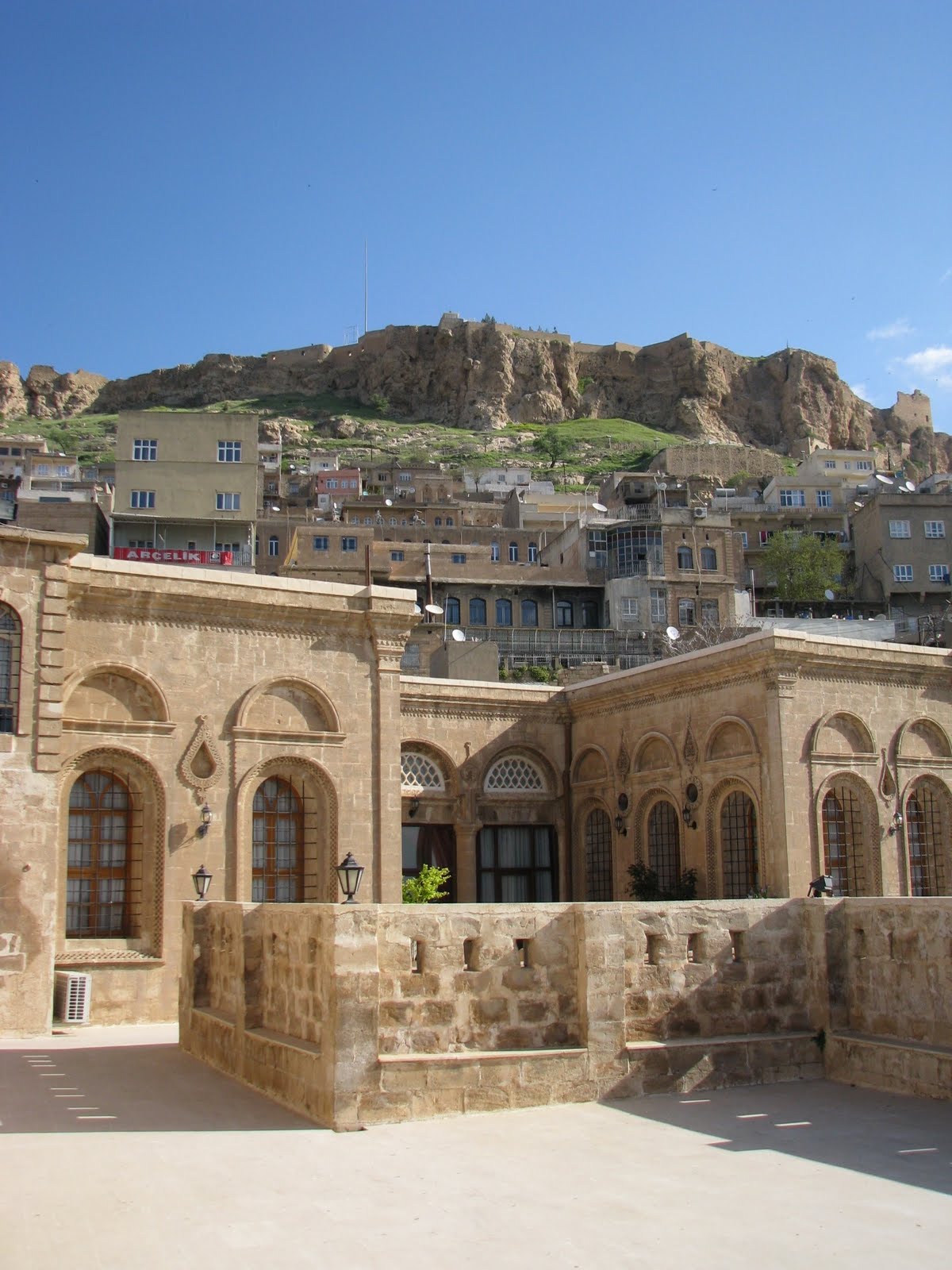


Memet picked us up and took us to an outdoor cafe for tea. With the language challenge, he often settled for silence rather than trying to explain to us the plan. So we just went with the flow, and realized he wanted to take us to each special spot in Mardin for the right view, the right ambience, the right cup of tea. Afterwards, we drove 6 km outside of Mardin to Deyrulzafran, or "Saffron Monastery" named for the color of the yellowish rock used to make the buildings.


This monastery was built in 493AD, and was from 1120 to the 1920s the seat of the Syrian Orthodox patriarch, which has since been relocated in Damascus. It is still in operation, rumored to have two monks working there and about 25 orphans, though we didn't see any on our tour.
Syrian Orthodox priests believe that the Syrian Church was established in this area during the lifetime of Christ. Today, the core uniqueness of the Syrian Church is that the liturgy is in Syriac language, written from right to left, having evolved from ancient Aramaic, the mother tongue of Jesus.
The underground vault was the most interesting part of the complex. It was supposedly used as a temple by sun worshippers as long ago as 2000BC. So when the Syrian Church established this monastery in 493AD, this temple was already here. The window once used to worship the sunrise is now mostly blocked. The vault's ceiling is constructed without mortar; the stones are 3 meters thick and held together using the keystone method.


Services are still held here in the chapel, and the patriarch sometimes visits from Damascus. There are also guest rooms in which people can stay for religious visits. Another example of a layering of religions, from ancient times to present use.


After Memet's treating us to lunch, and our expressions of gratitude which just did not seem enough for the last 24 hours of feeding us and carting us all around the sites of Mardin, we headed West towards Nemrut Mountain.


Storks!


We crossed the Euphrates River by ferryboat (and I had a flashback to Laos).


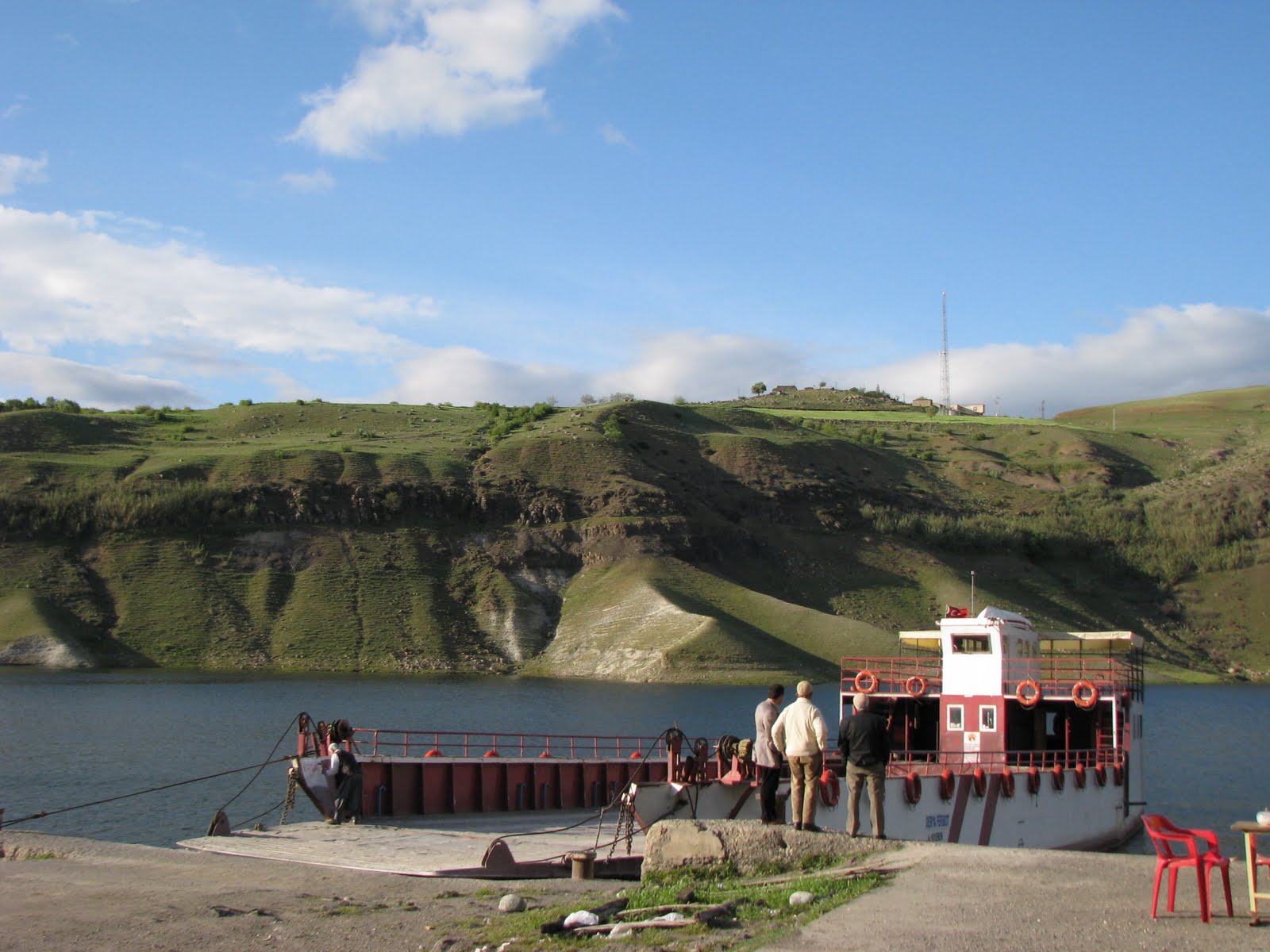


That night, we stayed in a pansiyon in a small village, Karadut, about 12km from the summit of Nemrut Mountain. The next morning, we woke up at 4:30am and drove up to see the famous sunworshipping shrine at sunrise.


The temple consists of a row of stone gods seated facing the sunrise on the east side of the summit, and another series of stone gods on the west side facing the sunset. The temple and tomb complex were built by Antiochus I Epiphanes (64-38 BC), the son of the founder of the Commagene kingdom, which was a breakaway dynasty from the Seleucid Empire, remnants of which can only be found within a small radius of Nemrut mountain. Antiochus was a megalomaniac and built this temple as a monument to himself. He claimed descent from Darius the Great and Alexander the Great. A German engineer came across this site in 1881, but it wasn't until 1953 that a comprehensive archeological survey of the site began. At the eastern temple, you will find six decapitated seated statues, the heads measuring about 3 meters in height. They represent Apollo, Fortuna (a symbol of the Commagene Kingdom), Zeus, Antiochus himself, Hercules, and an unidentified statue.
It was freezing; Christy and I walked up in our sleeping bags.


The temple was meant to incorporate several different deities from different cultures, modeled after Alexander the Great's principle of syncretism, in order to foster a sense of unity among disparate peoples within his empire.
On Antiochus' birthday, the Commagene people supposedly filed up the mountain to witness the sunrise and make sacrifices and offerings to the gods on the alter which Christy is standing upon. The lion is a guardian of the altar. On the western side, which was covered in snow, there is supposed to be the first astrological relief: a depiction of Leo the lion (my sign!), but we weren't able to find it under the snow.


We had a long drive ahead of us that day, especially tiring since we started the day at 4:30 (which was totally worth it). The first place we stopped was to see an old castle from the Commagene Kingdom.

Next, we visited Septimus Severus Bridge, a Roman bridge built between 193 and 211 AD. Only three of the original four columns are in place, because when one of Septimus' daughters was killed, he had one of the columns removed.


That night we stayed in Urgup once again, a familiar place, yet not quite the bussling metropolis that is Ankara. Our drive the next day was short and sweet, a nice way to work our way back into central Anatolia. Here is Christy enjoying the comfy armchair at a gas station where we ate lunch:

And this concludes our awesome Spring Break travels. This may have been my favorite part of Turkey so far, and I look forward to returning to this part of the country next year.


