Wednesday, October 10, 2012

Chios

Last weekend, my friends and I took the ferry from Cesme (a nearby beach town) to the Greek island of Chios.  Here we are bright and early on the Saturday morning ferry:
Just a short hop, skip, and a jump away from Turkey!
So close, but so different!  As soon as we docked, I noticed a hint of European in the architecture:
The most boring part of an otherwise wonderful weekend, the customs line:
We stayed in a hostel recommended to us by other teachers from ACI.  It was super cute and super cheap.  Tall tall ceilings, exposed beams, and the classic Greek look: white stucco exterior with blue shutters. Here's the interior:
 
And the views from our balcony:
 
   
For our first day of exploring the small island, we rented a car and a motorcycle for the seven of us, and headed 15km inland to tour a UNESCO World Heritage site called Néa Moní, or New Monastery.  When we first pulled up, I noticed the silence and these prayer bundles fastened to tree branches. 
All the monasteries I’ve visited in Turkey and Spain have been perched in out-of-the-way hillsides like this, closer to the heavens, and all have contained the same stillness in the air.
But as we explored the grounds, the stillness I first noticed seemed more connected to an aftermath than an absence of turmoil.  For one, the monastery was surrounded by burnt forest, the remains of the forest fire that swept through these hills just a month ago.   
We hiked through the burnt forest to discover a small chapel with a padlocked door and a grated window for peeping in.  Inside, thousands of skulls stared back at us, laying atop neat piles of bones along the alter.  Shocking and creepy!  We soon realized there was definitely a story we were missing.We soon learned on our tour of the grounds that the story is one of fires, earthquakes, and massacres. I've since done a little research to fill in the rest of the gaps:
According to legend, one night three hermits noticed a strange light coming from the mountain where the monastery is now built, but when they went to explore it the next morning, the light was gone.  To discover the will of God, they decided to set fire to the site. The fire raged along the slope until suddenly dying out, leaving one spot unmarred. In this spot, there was a myrtle bush, and from its branch hung an icon of the Virgin Mary.  The hermits brought the icon to the cave where they lived, but miraculously it continued to return to the place where it was originally found. The hermits decided to build a monastery around its place.  The original monastery is referred to as the Old Monastery.


One day the Virgin Mary icon told the monks there that the general, Konstantinos Monomachos, then exiled in Lesbos, would be emperor. They went to the nearby island of Lesbos and informed the general of this prophecy. He told them that if it should come true, he would reward them.  The men asked only that he build them a new church for the Virgin Mary icon.
We continued to hike up the hill through the burnt forest to discover this newer monastery.  Several Greek Orthodox priests opened the door to let us come in.
Two years later, Konstantinos was unexpectedly called to be emperor of the empire’s capital, Constantinople.  Keeping his promise, he built a church dedicated to Mary at the site where the Old Monastery was. The work continued for 12 years, and after the death of the emperor, his widow brought it to its completion. This is the Néa Moní, or New Monanstery, which we visited.
(The legend is adapted from http://www.mesogeia.net/trip/xios/neamoni1_en.html
But the story doesn't stop there.  The Monastery went through devastating times in the 1800s.  The Néa Moní was burnt down by the Ottoman Turks during the massacre of 1822, and then was greatly damaged by the earthquake of 1881.  The icon supposedly survived both of these undamaged, and hangs today in the church. You can see it in this picture.
These are pictures of the exterior of the chapel.  You can see the older stonework next to the newer stonework, renovation after the earthquake.


The chapel was built inside a cave:

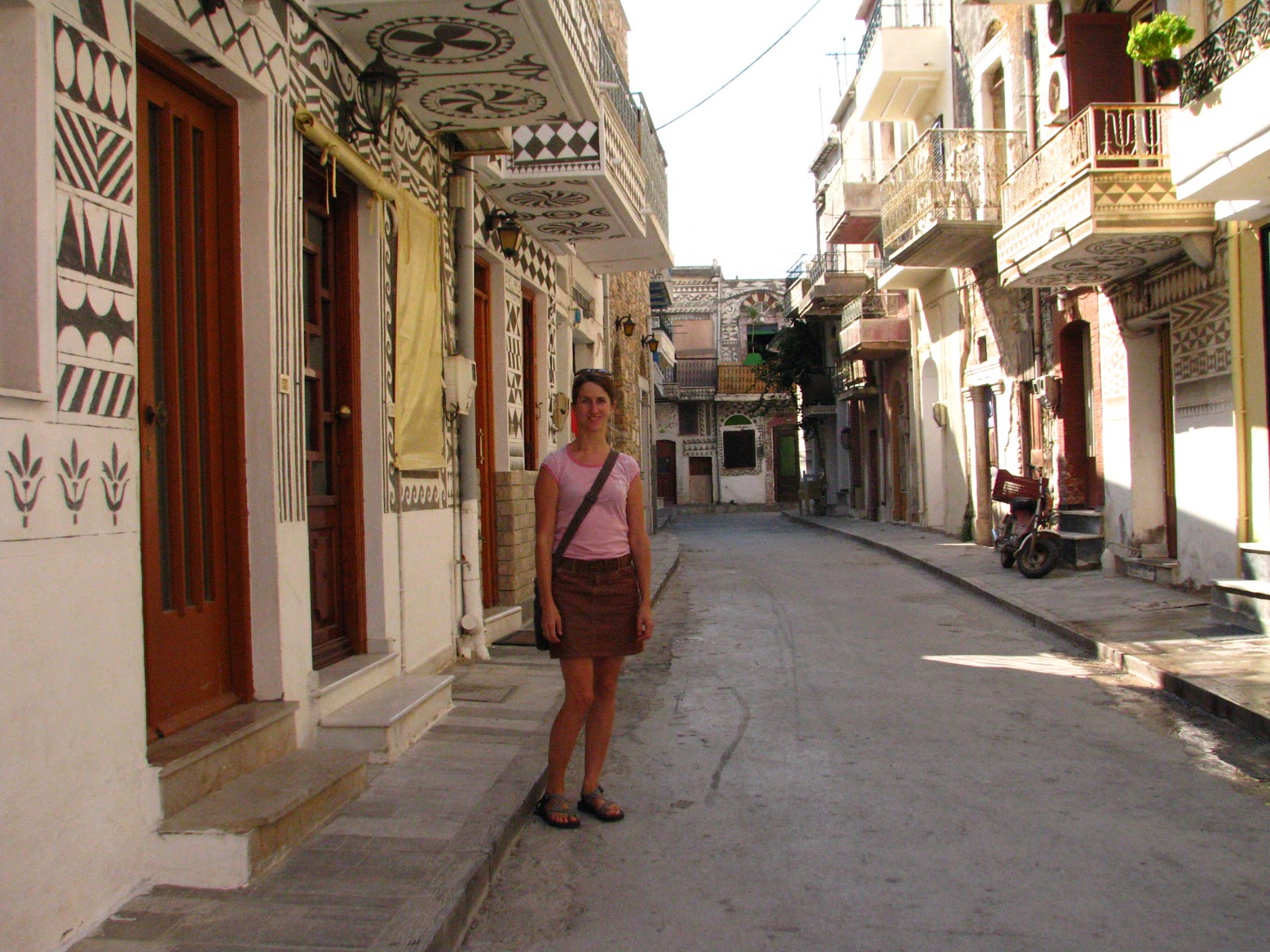
On the second day of exploration, we drove to a medieval village called Pyrgi.  It was built in a fortresslike complex of narrow streets for protection against pirates and invading Turks. The distinctive  technique used to decorate the exteriors of the buildings is called Xysta.  To create Xysta, the outer layer of cement is painted white and then geometric shapes (triangles, circles, etc.) are scraped away, exposing the black base. It is based on the Italian form of decoration called Sgraffito which stems from Genoa, Italy. People from Chios traveled extensively due to its strategic location and brought back the technique from Italy.
It also seemed the custom to hang out tomatoes to dry, creating a stark contrast of color.
This is one of my all time favorite door pictures:
This 13th century Byzantine church is in the town square.  The same striking design covers its exterior.  This is also where the old guy tending to the church kept trying to cop a feel of my girl friends and I. What's up with the old creepers hanging out in mosques and churches?  Ironically, these are the only places where uncomfortable things have happened to me during my travels.
The oldest church in town (12th c.):
The town square.  Okay, it's official. I miss Catalunya a little bit.  And being in Chios felt like I was touring a medieval village in Catalunya, or having lunch in the clocktower plaza in Gracia, Barcelona.  It's so funny how I could sense I was in Europe. Greece and Turkey use so many similar ingredients for their food, and the landscape is exactly the same.  But just changing the architecture so that a town is organized around a town square, preparing the food in different ways, and the way the country roads were built to wind through the small towns perched on hills... all these made me feel like I was in Spain again, even though Greece may have more in common with Turkey.
Then we drove to the southern tip of the island, a region where they grow mastic, a substance used in gum, cosmetics, and medicine, historically a major source of income for the island's inhabitants.  But we quickly passed the mastic farms, because we were headed for this beach, which we named "Paradise Found."
  
 Bye-bye to Chios for now!  Surely, we will be back again and again to explore more medieval villages, eat yummy Greek food, and swim on more gorgeous beaches...

Friday, August 17, 2012

Back to Turkey! Volunteering at an Organic Olive Farm

For the last two weeks, I disconnected from technology and creature comforts, and lived and worked on an organic olive farm called Dedetepe near Kucukkuyu, a small town on the Aegean coast of Turkey.  There were a total of 19 inhabitants on the farm, owners and volunteers coming and going.  We ate an all organic, vegetarian diet made from products either produced on the farm, bartered with neighbors, or purchased from organic farmers at the Friday market.  We took turns cooking and cleaning with one another, in between the volunteer hours we spent working on projects on the farm.

Dedetepe Farm hosts two kinds of volunteers: WWOOFers (Willing Workers on Organic Farms) and EVSers.  EVS (European Volunteer Service) is like the European version of the Peace Corps.  Turkey’s branch of WWOOF is called TaTuTa (my host organization), and falls under the umbrella organization, Bugday.  Bugday is dedicated to educating Turkish farmers on ecological, organic, sustainable principles.  I learned from a Bugday volunteer that the pesticides in Turkey were off-the-charts in a recent Greenpeace study of exported produce, that Turks call pesticides “medicine” and many think of them as modern methods for healthy farming.  Bugday is trying to fight this mentality as well as ward off the GMO lobbyists in Ankara.


Dedetepe Farm was originally a Bugday project.  They wanted to create a sustainable organic farm as a model to other farmers in Turkey.  Therefore, all the farm’s electricity is supplied by solar panels  
and a windmill.  
The farm’s water is entirely provided by the river; a hydro-pump pulls up water every day to fill a pool, and from that pool, they irrigate the olive trees, wash dishes, flush toilets, bathe, etc.. 
  
Inhabitants take mind to consume as little electricity and water as possible - taking few showers (which is easy when the river is nearby to swim and cool off in several times a day), flushing limited water in toilets, watering plants sparingly and only at night, cooking food like pasta with already hot water from the solar panel tanks, etc..  The farm does not have refrigeration so everyone aims to cook small meals and eat all of it; food that goes off is fed to the dogs and other food waste is either composted or fed to the chickens, horse, or rabbit. 
 Because there is no refrigeration, the ingredients for cooking are simple: fresh vegetables, legumes, grains, olive oil (from the farm), and spices.  
Here's a visual tour of the grounds:

Tent area:
Guest cabins:
 
Social area:
The hamam:
Yurts (guest accommodation):
The Montessori school:
The yoga platform and ampitheatre:
The campfire area:
The open-air kitchen:

Initially, the working energy of the farm felt different from the synergy I experienced on WWOOF farms in Italy seven years ago.  Everyone at Dedetepe seemed to be doing his own project and many were doing office work on their laptops in the “office,” an open-air platform with cushions and low tables.  I then learned that there are many regulations as to what a host farm can ask of an EVS volunteer.  There are also Bugday employees working on the farm, engaged in long-term development projects.  Together, the EVS volunteers and Bugday employees were doing more office work than manual labor (than the WWOOFers), or so it appeared to me.  But the entire community came together for cooking, eating, and socializing in the evenings.  Once I adjusted my expectations, I enjoyed the solo time working, then convening around the kitchen table with everyone when “Yemek hazir!”  (Food’s ready!) was announced.  The farm reminded me of Big Creek, but without the children. 


Everyone had such a mix of projects they were working on: soap and paper-making,  
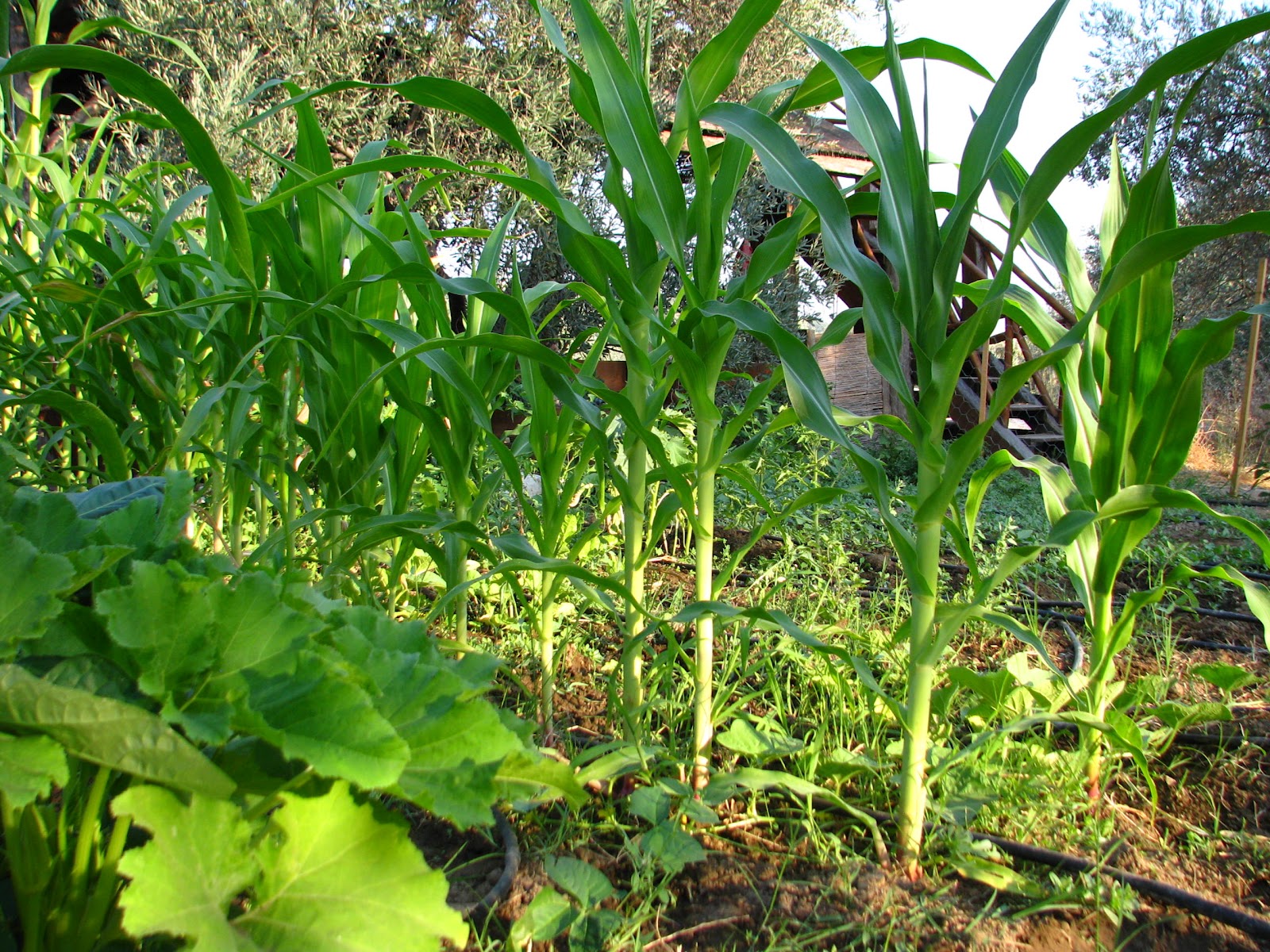
veggie gardening, 

olive-tree tending,
 animal care, refurbishing school benches for a village school. The idea was to work six hours a day (general rule for WWOOF farms). As Nick, the farm manager said, “The farm gives a lot to us; it’s important to give back.” Being a short-term volunteer (many of the volunteers had been there for over six months), my work was a bit piecemeal.  Beyond doing daily chores, I helped with a few projects underway.  

My first project entailed taking care of the young olive trees.  There are old olive trees grandfathered into the property which are the farm’s main source of revenue (olive oil),  
and there are over 70 three-year-old olive trees which are an investment for the future. These young trees are suffering from the heat/drought, so it became our principal focus to save them.  I helped to build dirt mounds and moats to better hold their water and tied the irrigation system to their bases.

My next project was refurbishing school benches for a village school in-the-works.  In an effort to attract and provide for the educated Istanbulites moving to the countryside, the farm was involved in a project to begin a village school.  
I enjoyed painting the benches the most.  This is where the country of Laos is spot-on with their compulsory monastery service.  Simple, menial, repetitive tasks done for no compensation ground and center you like no other experience. Slow and steady, my mind could be simple and present. Wash the dishes to wash the dishes, as Thich Nhat Hanh said.  Listen to the sounds around me, feel the sun on my back, address the thoughts as they pass through.  Of course, as an educator, I also loved that one day these would be of use in a classroom.  

The first day I arrived was the full moon, and the farm inhabitants convened for a “Full Moon Party” at night to drink Adam (one of the volunteers)’s home-brewed pekmez beer.  Pekmez is grape molasses, and is used as a sugar substitute for everything on the farm.  The next morning there were some pretty rough hangovers from the stuff!


When I first arrived, I went through this death phase in the middle of the day when it was so hot that I’d lay in the hammock during siesta time and go in and out of sleep (if that’s what it was?).  I felt antsy that I should be doing more and feeling less lethargic.  But lethargy is the child of heat, moving, jetlag, transitions, and I had all of those stacked up against me.  Slowly, as I slipped into the farm’s rhythm -waking early to work before the heat of the day, taking a long siesta then when the heat subsided at 5pm, working again for a few hours- I moved from using the siesta to die-in-the-hammock, to studying Turkish, doing yoga, writing.  Also, the farm has an icecube-cold pool in the shade, fed by and perched above the river.   Jumping in that was incredibly rejuvenating!  But even after I adjusted to farm life, hammock time was still an essential part of the day.

With scratches up and down my legs, dirt under my toenails, a back adapted to sleeping on the ground in my tent, and hair oil adapted to a once-a-week shower, I left the farm feeling stress-free, refreshed, and ready to tackle my next adventure in Izmir. 

Now in Izmir, with a population of 3 million, I am aiming to live with many of the principles I used at the farm.  Ten years ago while working at Big Creek, these principles were my mantras.  Somewhere along the way, either city-living or laziness gave way to convenience and creature comforts.  My experience at Dedetepe was a reminder to recover these root principles: to eat simply, consume less, re-use more, and educate when I can.