For Seker Bayram this year, I drove to Sinop with my friends, Dale and Rukiye. Another trip to the Black Sea, this time a little further East to the northernmost point of Turkey. Sinop is only 200 nautical miles from Crimea, and used to host one of NATO's listening posts.




Sinop is a town of about 30,000. It hasn't caught up to the nearby towns' beach resort feeling. The guidebook calls it a sleepy town. I don't know if it was because of the bayram, but it was anything but sleepy. People were out til midnight (rare in a small Turkish town), although "laid back" would still be a good word to describe it.

It was fun to be in a town that was celebrating Seker Bayram. Sinop is a more conservative town that Amasra, and so we expected these festivities. Dale bought a bag of candy to give out to children we met on the streets. Seker means "sugar;" this tradition of giving sweets to children gives the holiday its name.


We spent lots of time at the tea gardens lining the harbor.


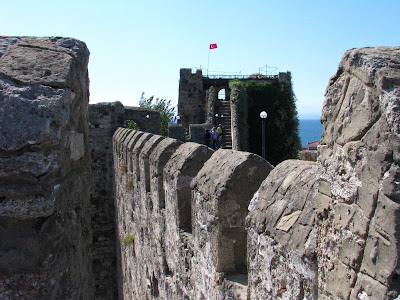
The peninsula of Sinop has been inhabited since the Bronze Age, but the oldest evidence of civilization consists of 7th c. BC Pontic fortresses on the isthmus, the narrowest point of the peninsula.

We stepped inside this small, empty mosque to explore...


Alaeddin Mosque is a 13th c. Selcuk mosque, the oldest in town complete with tree shaded courtyard. We stepped in to pray; notice the women's area is upstairs behind latticework. Unless you put your eye (or camera) up to a hole, you can't even see the imam leading the service.


Behind the mosque was the Alaiye Medresesi, which dates to the 1260s. This once religious school has been converted to shops.


Sinop gets its name from the Amazon queen and daughter of a minor river-god. Sinope attracted the attention of Zeus, who promised her anything she wanted in return for her (sexual) favors. Her request was for eternal virginity, which Zeus did grant her. "Take that, Zeus! (pause) Wait a minute..."
We wandered around the ruins on the isthmus and felt her presence. Almost saw a mermaid, too.


Another one of Sinop's claims to fame is one of Turkey's oldest prisons. Hard to capture, but this was a dungeon-like room containing no light, only a shackle to the wall.


The drive around the northernmost part of the peninsula was blustery and beautiful, like a fall day in Montana, or how I'd imagine the coast of Ireland to look.


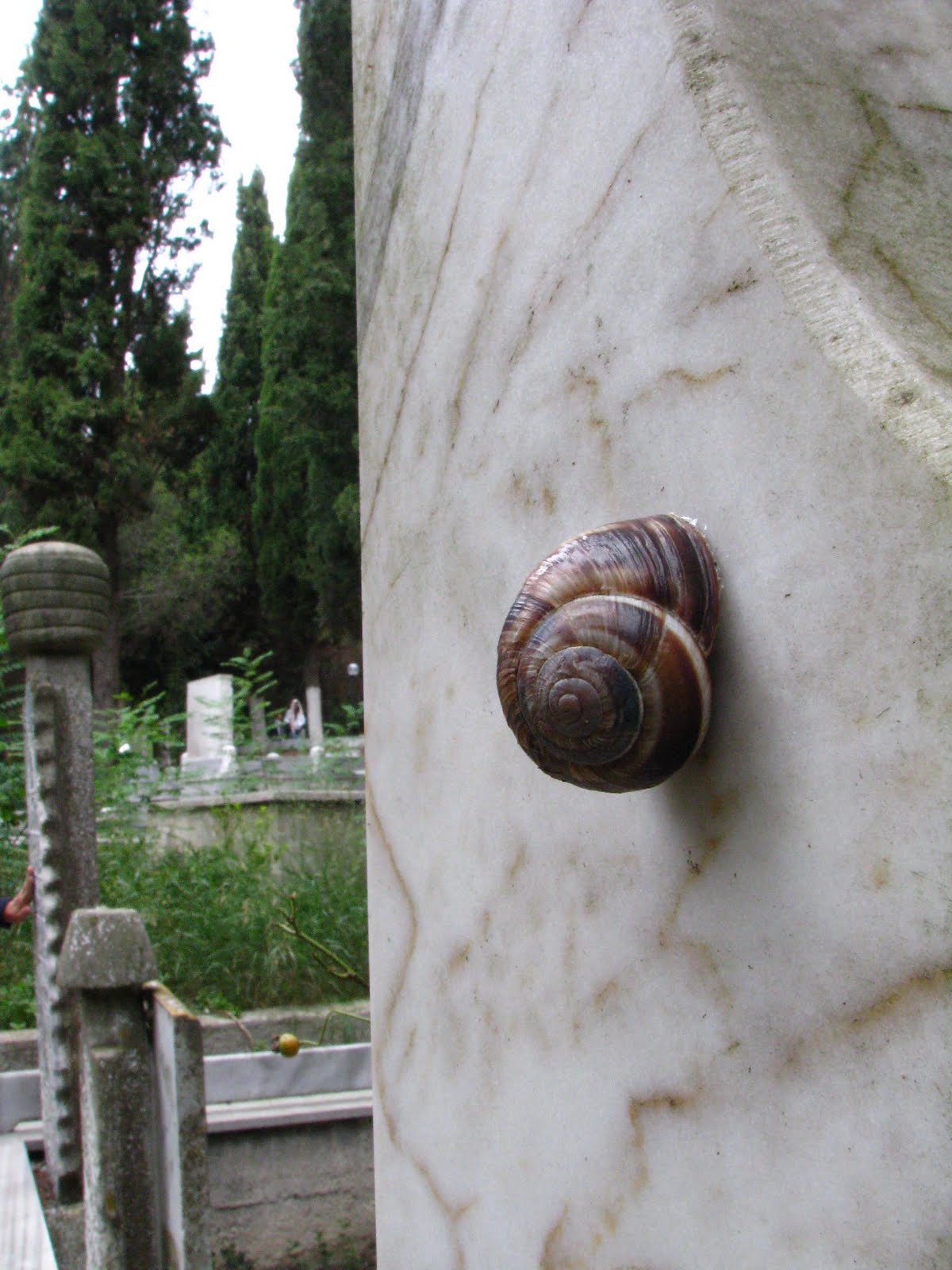
We stopped at a cemetery with the best view in Turkey (the Black Sea). I discovered that teachers, soldiers, and doctors have their professions written on their gravestones because they are such noble, altruistic professions (Note that this
is a teacher's interpretation, but no lie, "teacher" was written on several gravestones:"ogretmen"). Water pots were built into many of the raised graves, and bottles of water were stashed away all over the cemetery. It's customary to sprinkle water in gravebeds, to nourish the plants, the dead, the snails.


Diogenes the Cynic was born here in the 8th century BC. He seemed like a true Montanan. At some point in his life, he wanted to show people that one could live with very little in terms of material items or wealth, and he lived the rest of his life in a barrel. I also love this anecdote about him: Alexander the Great admired him and is known to have said, "If I were not Alexander, I would rather be Diogenes." He had also asked Diogenes if he could do anything for him, to which Diogenes replied, "Yes, stand aside, you're blocking my light." What a couple of pompous pricks!
His statue greets you as you enter town:


Stormy day at sea...

We visited a museum to see what kinds of things were unearthed in Sinop. Roman amphorae (the pottery) and mosaics were the most interesting. The kiln was put together by Bilkent University's archaeological department.
I also read this on a plaque, and loved it:
"If life is a sentence, then death is a full stop," said a thinker. Grave stones, in other words, steles, are silent and the only witnesses of this reality. Steles which are standing on the grave and the dead which were once living, laughing, and walking are now together like bosom friends. Grave stones are like faithful lovers who are waiting for the death under the earth. They stand as a resistance against forgetfulness."


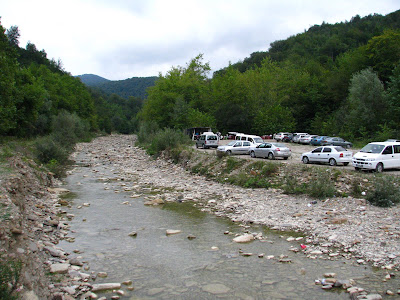
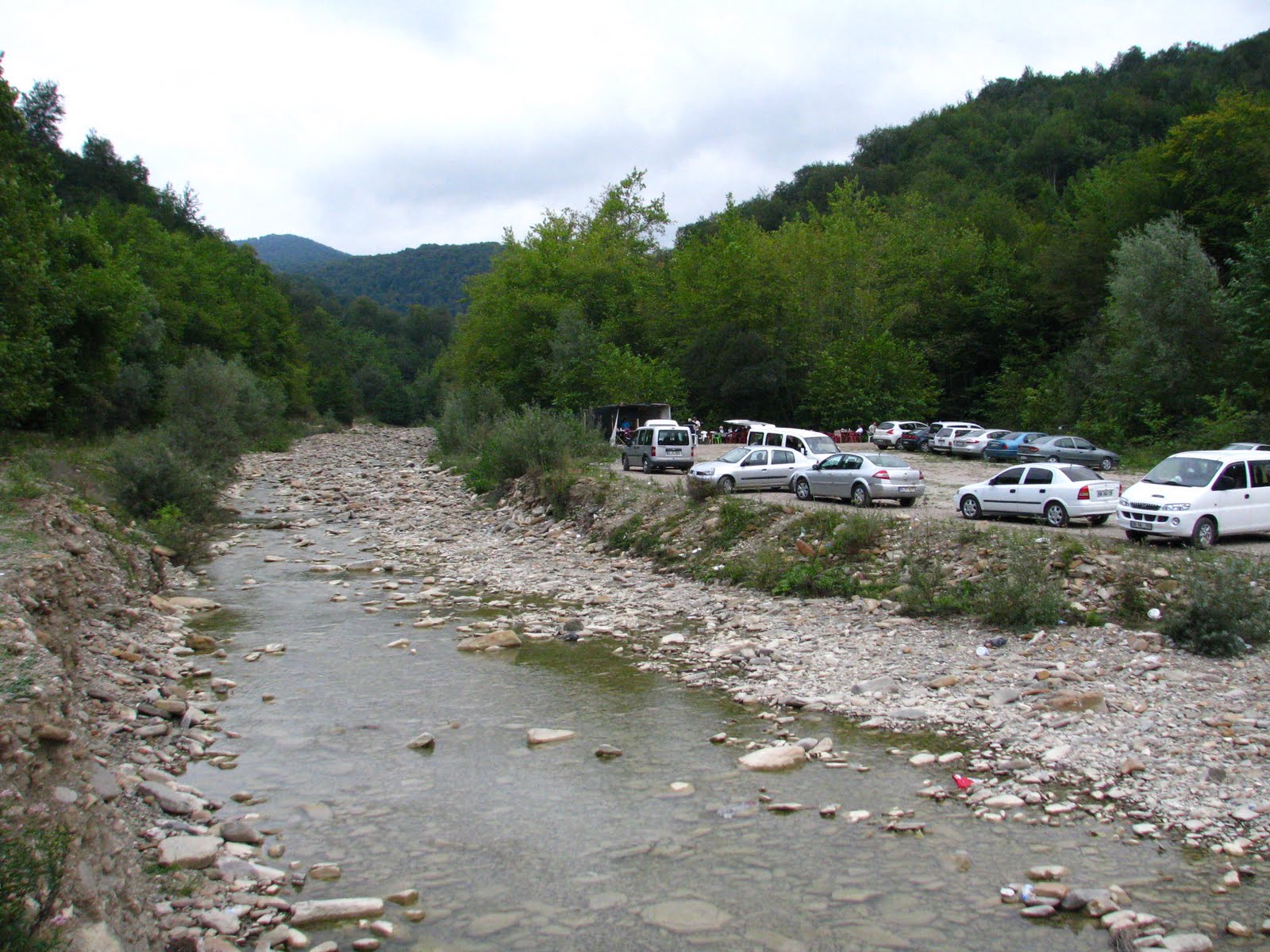
On our way home to Ankara, we stopped at Tatlici waterfalls outside a down called Efelek. We were hoping to hike around and see some of the 28 waterfalls in this national park, but when we pulled up to the parking lot, every Turk from within a 100km radius seemed to be having a picnic there with his entire extended family. It was a little much for this Montana girl. We just hung out by one waterfall, then ordered some tea and gozleme before heading back to Ankara.