Sunday, May 1, 2011

King Midas of Gordion


A day trip to Gordion, the capital of Phrygia, 90 km west of Ankara.

The original settlement of Gordion dates back to the Bronze Age, but is best known as the capital of the Phrygians. The Phrygians were a Balkan people who reached Gordion from southeastern Europe. The Phrygians followed the collapse of the Hittites, and dominated western Anatolia from the 8th century BC to 700 BC. King Midas was their last ruler; he was reported to have committed suicide in 714 BC when the Cimmerians of what is now south Russia invaded Gordion. There's little left of the records of the brief flowering Phrygian Empire, excepting the myths associated with King Midas, the most important Phrygian king. Also, Phrygia was the first state west of the Euphrates to develop an alphabet. After the Cymmerians destroyed the Phrygian Empire, the city was occupied by the Lydians for a short spell, then the Persians, and in 333 BC, Alexander the Great wintered in Gordion during his great march eastwards. The legend of the Gordion knot comes from his stay.

 Here's the story:

An oracle foretold that a poor man would ride into Gordion by ox-cart and one day rule the Phrygians. As the king and his subjects were discussing this prediction, in rode a farmer named Midas. King Gordios, who had no sons, named Midas his successor and Midas' cart was placed in the temple where it would stand for half a millenium. Somehow the belief also arose that whoever untied the knot that fixed the cart to its yoke would become ruler of Asia. It was Alexander the Great who severed the Gordion Knot during his winter stay in Gordion. He did become ruler of Asia, but he also died at 33, and the superstitious thought his early death was a result of his severing that knot.

Today, there is a small town on the site of Gordion called Yassihuyuk. But, really, you're in the middle of nowhere.


First, we hit the museum. There was a plethora of pottery, brass fasteners, and figurines. Even gutter systems complete with decor. All these things are from peoples who have settled in this site from the Bronze Age onwards. I took pictures of the things that caught my eye, but what most interested me was the bottom line that human beings have always had a need for decorating and surrounding themselves with beauty.


Tumuli (large artificial hills of dirt covering tombs) dot the landscape around Gordion, the largest of which is called King Midas' Tumulus, although it has not been proven that he was actually buried there. Material found within the tomb suggests it possible that it was a later Phrygian king's tomb.


The tumulus is 300 meters in diameter and over 50 meters high. The burial chamber is at the end of a 60-meter tunnel bore by American archaeologists in the 1950s.


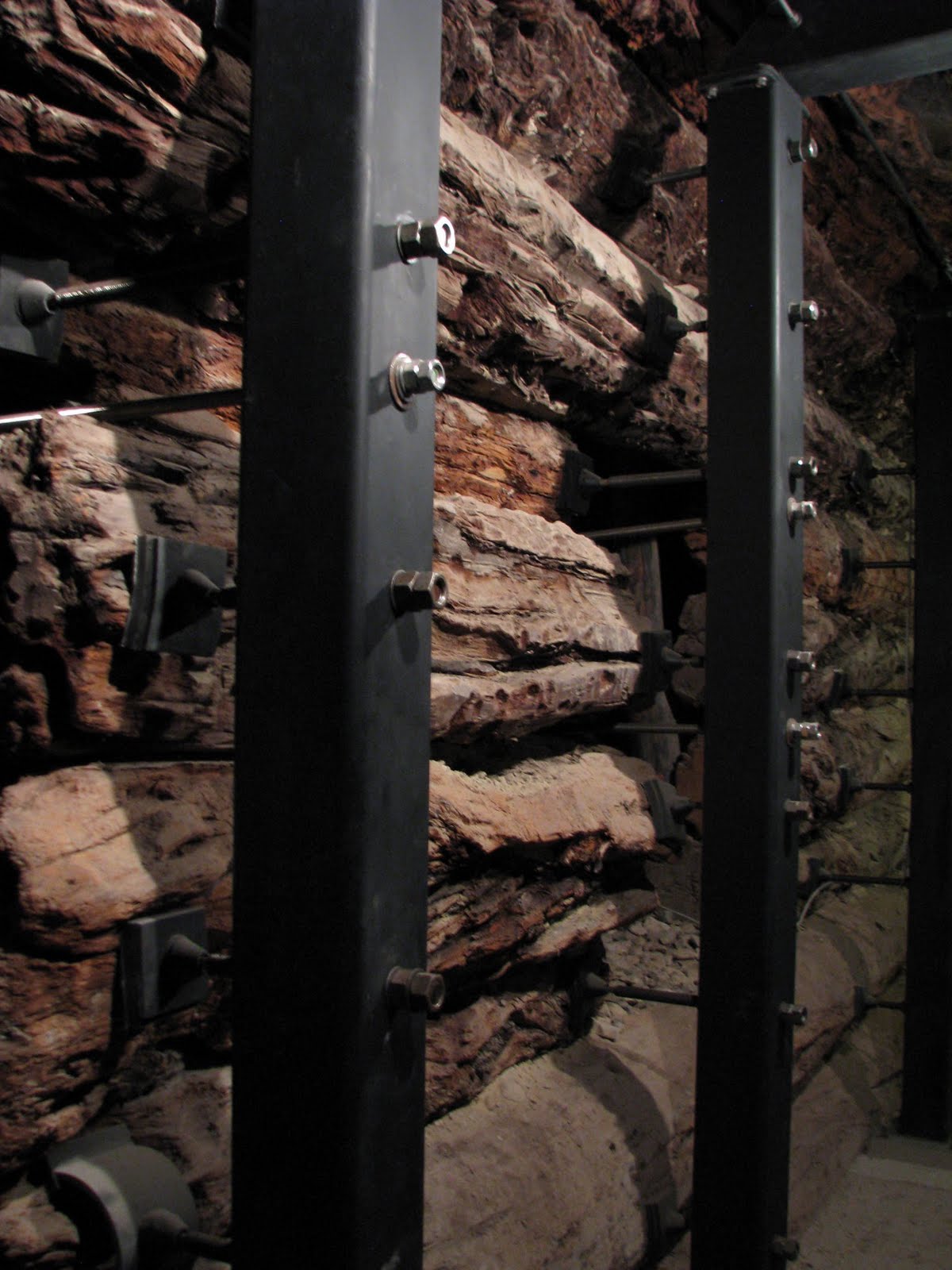
The actual tomb consists of gabled pine logs, the oldest wooden structure in Anatolia. The logs have been preserved under this mound of dirt since 725 BC.




I kept asking if tumuli were artificially created. Seems like a lot of work to move all that dirt, pre-bulldozer. But I guess it's like a small scale of the Egyptian pyramids. The tumuli were the first clue to archaeologists that people settled in this area. From a bird's eye view, the mounds look out of place geologically. Today, even the gophers of Gordion have caught on to the tumulus idea:


The other site worth visiting is the raised acropolis. You can walk around its perimeter and look down into the excavated site. This site was the heart of the city, home to the royal palace, temples and government buildings.


Remains of a huge Phrygian town gate, over 10 metres high, make the gate one of the biggest pre-Classical buildings in Anatolia:


At the heart of the palace are four megara, large halls with a kind of porch. One of these megara had a floor mosaic of geometrical patterns. These pieces were excavated and moved to the museum:


Overall, I was surprised to find the capital of the Phrygian Empire to be such a small city. It's hard to believe it once dominated western Anatolia. It's also hard to believe that a group of people, the Cimmerians or "Sea People," came all the way from what is now southern Russia to conquer this "empire." Considering all the empty land between them, like magnets these different people found each other in the high desert to dominate a region, not even out of vying for resources.

Now the fun part. The legends. King Midas. (It's so fun to stand in the "homes" of stories I read as a child in a far away land.) Several Phyrgian kings bore the name Midas, so over time emerged a composite mythical figure "King Midas." The best known story is that of King Midas and the Golden Touch. According to this legend, Midas captured the water demon, Silenus, after getting him drunk by pouring wine into his spring. In ransom for Silenus, Midas asked Dionysos for the ability to turn all he touched into gold. Dionysos granted him this wish, but Midas was dismayed to find that all he touched did turn to gold, including his daughter and his food. (Imagine getting what you wished for!) So he begged Dionysos to release him from the curse and Dionysos ordered Midas to wash his hands in the River Pactolus. The cure worked, and thereafter the river ran with gold.


The second famous Midas tale is this: Midas was asked to judge a musical contest between Apollo and Marsyas. Midas decided in favor of Marsyas and in revenge, Apollo caused Midas to grow donkey's ears and skinned Marsyas alive. Midas tried to hide his new appendages under a special hat, but could not hide his donkey ears from his barber who, desperate to tell someone the king's secret, whispered into the reeds by the river, "Midas has ass's ears." The river reeds whispered this gossip for ages. Unfortunately that river has since changed courses and no longer runs by the site of Gordion. However, I did videotape the grass on top of the acropolis. Tell me if you hear anything:


Some poetography from the day:


Sunday, April 24, 2011

Paris in the Spring

>

This year, for some reason, I found myself traveling to Europe on my breaks: Venice in the fall and Paris in the spring. For our much-anticipate Spring Break, last week my friend, Katy, and I traveled to Paris for five days to visit our Turkish friend, Gozde, whom we met acting in the pantomime this fall. Through the Erasmus program, Gozde is in Paris for a semester of working on her phD. The three of us stayed with her friend who has an apartment just around the corner from the Eiffel Tower. We enjoyed the perfect mixture of relaxing in sidewalk cafes and walking the streets, seeing some famous sights, accidentally lighting on fire a napkin in a fancy restaurant, and belly-laughing.


On our first full day, we walked along the River Seine alongside used book stands, a tradition occurring here since medieval times. As we walked, we watched the original island of Venice start and Notre Dame come into sight.


We crossed the bridge to Notre Dame, and came across these padlocks on the "Bridge of Love," where sweethearts have padlocked their love.


Notre Dame was by the far the most impressive church I've seen in Europe. Everywhere you looked, an intricate story was carved into the stone. Its construction began in 1150AD and took 200 years to finish; the foundation was built by volunteers who could only imagine their great-great-grandchildren enjoying the fruits of their labor.


And in the Gothic style, the church was just drippppping with gargoyles.

I looked up the myth of the gargoyle on wikipedia, and here's what it said: "French legend that sprang up around the name of St. Romanus ("Romain") (AD 631–641), the former chancellor of the Merovingian king Clotaire II who was made bishop of Rouen, relates how he delivered the country around Rouen from a monster called Gargouille or Goji. La Gargouille is said to have been the typical dragon with batlike wings, a long neck, and the ability to breathe fire from its mouth. There are multiple versions of the story, either that St. Romanus subdued the creature with a crucifix, or he captured the creature with the help of the only volunteer, a condemned man. In each, the monster is lead back to Rouen and burned, but its head and neck would not, due to being tempered by its own fire breath. The head was then mounted on the walls of the newly built church to scare off evil spirits, and used for protection.[4]"


Here's a few pics from inside the church:


Across the bridge from Notre Dame, we visited a famous bookstore called Shakespeare & Company in the Latin Quarter. The Latin quarter has been the home of bohemians since medieval times, when the language of intellectuals was Latin and what you heard on the streets. In that tradition, an American woman, Sylvia Beach, opened this English bookstore here during Post World War I when many American writers were moving to Paris because the rent was cheaper and the atmosphere was more free than prohibition America. She offered upstairs apartments to struggling artists, and helped James Joyce publish Ulysses when no one else would. Gertrude Stein, Ezra Pound, Ernest Hemingway, and F. Scott Fitzgerald, among others visited this bookstore for their English books. I could've spent all day in there.


It's always fun to be in a Christian country during holidays, for the familiarity. As we were here a week before Easter, chocolate stores had amazing chocolate Easter displays, and amaaaaazing chocolate in general.


We stopped for coffee in the same cafe Sartre frequented and discussed existentialism in its early days. The city was full of literary ghosts, which I loved. Not only stories, like The Hunchback of Notre Dame and The Man in the Iron Mask, but it seemed like every cafe was home, at some point, to a famous author.


The following pictures are from our evening walk that night along the Seine and to the Arc de Triomphe, which we climbed to view the city.


The Basilique du Sacré-Cœur can be seen in the distance. Since our baggage was lost arriving in Paris, I didn't have my camera the first day. But that was the day we bought a baguette and a bottle of wine and hiked up the Montmartre Hill to visit Sacré-Cœur (The Church of the Sacred Heart). We sat on the steps overlooking the city and, over a bottle of wine, caught up with Gozde, whom we hadn't seen in a few months.

The church is not only interesting architecturally (it was built in the late 1800’s in the design of the ancient Romano-Byzantine), but bears an interesting story, too. During the years following the French Revolution, there was a schism in France between the devout Catholics/royalists and the socialists. It was a trying time for all. Many were starving still, and resorted to eating animals off the street (dogs, cats and rats). The church was built to inspire faith in the French people. During WWII bombs blew out all the stained glass windows but the church remained standing, giving locals the feeling that this church was, in fact, blessed. Our favorite fact about the church, however, was that at any given moment, a nun is on duty with the responsibility of directing her prayers to ask God for forgiveness of the sins of the world. In the main apse of the church, there is a mosaic among the largest in the world, called "Christ in Majesty," in which he opens his arms and bleeding heart to the visitors below.

Okay, back to our evening walk through the "City of Lights."


That pretty much sums up our aimless wandering. Since we had only five days in this magnificent city, we carefully chose our tourist activities to be visiting the impressionist paintings at the Musée d'Orsay (Monet, Degas, Gaugin, Van Gogh) of which I took no pictures, and visiting Versailles.

Versailles amazed me in the way Conrad's Heart of Darkness amazes me. When there are no checks and balances, there is no limit to what man can do.

The court of Versailles was the center of political power in France from 1682 when Louis XIV moved from Paris to this "suburb" 20 kilometers outside the city. The royal family ruled from this retreat until the French Revolution forced them to return to the capital in 1789.

Though the riches of the chateau had us "oohing" and "aahing," the wealth was so over-the-top. And the fact that the angry mobs of the French Revolution had dragged out King Louis XVI and Queen Marie Antoinette resulting in their trial and death, gave this beautiful place a strange feeling.


Everyone was milling about the chateau with handheld audioguides glued to their ears, which inspired this silly pose from us... which snowballed into the goofy "Triplets of Versailles" series you will see interspersed throughout the rest of my pictures.


The gardens were expansive, like the chateau. We had lunch at a cafe hidden away in a landscaped maze, then walked towards Marie Antoinette's hamlet, a 45 minute walk away. If we had been royalty in the 1700s, we would have taken a boat along the "Grand Canal" to her retreat. But alas...


Marie Antoinette's gardens of Le Nôtre consist of 86 acres of a pond, farm, windmill, and cottages. She was known to have idealized the life of the peasant, and prance around in lawn dresses and straw hats. It was here that she gambled, played parlor games, held concerts, put on plays with her friends in her very own theatre (we were a little jealous of this), and discovered the joys of a simpler life — churning butter, raising animals and growing a garden. This hamlet was so much like a fabricated fairytale world, you couldn't help but feel sorry for her. She seemed such a little girl.


On our final day we had sunshine, so we picnicked under the Eiffel Tower before catching our flight back to Ankara. It was complete with baguette, goat cheese, wine, strawberries and chocolate, so as you can see, we had become fully Parisian after just five days in Paris!